1557 Broadway: The First Horn & Hardart Automat in New York City
On July 2, 1912, Horn & Hardart opened its first New York City Automat at 1557 Broadway in Times Square, introducing a new way of dining to one of the busiest neighborhoods in America.
With its elaborate stained-glass façade, affordable meals, and coin-operated food compartments, the restaurant quickly became part of New York's changing dining scene. It was the beginning of an era that would make the Automat a beloved city institution for generations.
From Philadelphia to Times Square
The story of New York's first Automat began in Philadelphia, where Joseph Horn and Frank Hardart opened their first restaurant in 1888.
On June 9, 1902, the partners introduced the first Horn & Hardart Automat at 818 Chestnut Street in Philadelphia. Inspired by European self-service restaurants, the concept allowed customers to purchase freshly prepared food from glass-fronted compartments using coins.
The idea was a success, combining the convenience of quick service with the quality of a traditional restaurant.
A decade later, Horn & Hardart brought the Automat to New York City.
The company selected 1557 Broadway, between West 46th and 47th Streets, in the heart of Times Square. Surrounded by theaters, shops, offices, and a constant flow of pedestrians, the location was an ideal setting for a restaurant built around speed, affordability, and convenience.

A Remarkable Building at 1557 Broadway
The first New York Automat was more than a restaurant. Its architecture made it a recognizable part of the Times Square streetscape.
Designed by the Philadelphia architectural firm Stuckert & Sloan, the building featured ornamental terra cotta, large arched openings, and an elaborate stained-glass façade created by Philadelphia artist Nicola D'Ascenzo.
The stained glass incorporated the word "Automat" into an intricate decorative design. In 1914, an enormous rooftop sign bearing the names Automat and Horn & Hardart made the building even more visible along Broadway.

For decades, the building's distinctive exterior helped make the Times Square Automat a familiar landmark.
A New Way to Eat in New York City
When the doors opened in 1912, the Automat offered New Yorkers an unusual dining experience.
Instead of ordering from a waiter, customers approached rows of small glass-fronted compartments displaying freshly prepared dishes. After inserting the required coins, they turned a knob, opened the door, and collected their food.
Behind the machines, Horn & Hardart employees continually replenished the compartments from the kitchen.
The restaurant offered a wide selection of familiar foods, including sandwiches, baked beans, macaroni and cheese, pies, and desserts.
Coffee was another essential part of the Horn & Hardart experience. Served from the distinctive dolphin spout beverage dispensers, it became one of the most enduring memories of the Automat.
The system was efficient, but its appeal went beyond speed. Customers could see their food before purchasing it, choose exactly what they wanted, and enjoy a meal without the formality or expense of a conventional restaurant.
An Automat for Everyone
One of the most remarkable qualities of Horn & Hardart was its broad appeal.
The Times Square location welcomed theatergoers, office workers, shoppers, tourists, and neighborhood regulars. People from different backgrounds could sit alongside one another, enjoying the same food at the same prices.
There was no need for a reservation, no pressure to order an elaborate meal, and no requirement to leave a tip.
For a city moving at an increasingly fast pace, the Automat offered something especially valuable: a dependable place to eat well without spending a fortune.
This combination of quality, convenience, and accessibility helped Horn & Hardart become a fixture of everyday life in New York City.

How 1557 Broadway Helped Shape a New York Tradition
The success of the Times Square Automat marked the beginning of Horn & Hardart's expansion throughout New York.
Over the following decades, Automats appeared in neighborhoods across Manhattan and beyond. Their distinctive glass compartments, coffee dispensers, and familiar menus became part of the city's identity.
Although the company had its beginnings in Philadelphia, New Yorkers embraced the Automat as their own.
For generations, Horn & Hardart was a place for a quick lunch, a cup of coffee, an inexpensive dinner, or a slice of pie after a Broadway show.
The first location at 1557 Broadway helped establish a restaurant tradition that would continue in New York for nearly 80 years.
What Happened to the Automat at 1557 Broadway?
Like much of Times Square, the building at 1557 Broadway changed over the decades.
Its original stained-glass windows were eventually replaced, and later renovations and commercial signage concealed much of the historic façade.
In early 2024, the removal of billboards during construction briefly revealed portions of the original 1912 building, offering a rare glimpse of the architecture that once welcomed generations of Automat customers.
While Horn & Hardart no longer operates at 1557 Broadway, the building remains an important part of the company's history.
The last Horn & Hardart Automat in New York City closed on April 9, 1991, at 42nd Street and Third Avenue.
1557 Broadway in Today's Horn & Hardart Collection
The famous Times Square Automat continues to inspire pieces in today's Horn & Hardart collection.
Our Broadway Automat T-Shirt features the iconic signage that once welcomed generations of New Yorkers, while our Times Square Automat Coaster captures the building's memorable façade.
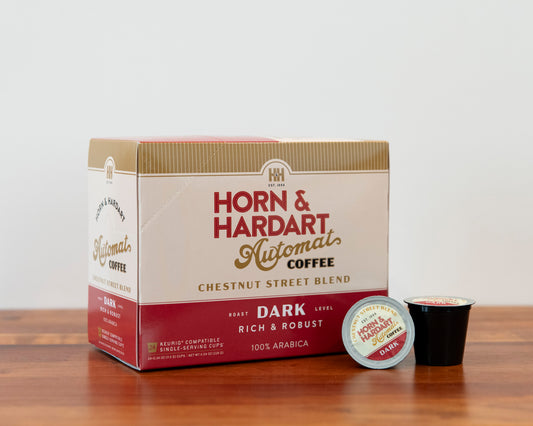
Explore more Horn & Hardart history in our story, or discover our Automat Coffee, inspired by the coffee served to generations of New Yorkers.